

NBF – This actually looks like a more credible and realistic plan. Tbhis is basing analysis upon the crappy plans by Stanford’s Professor Jacobson. This plan looks like it could be worth some further consideration. General limitations are I doubt they consider any economic growth that would require more power (it assumes you stay at the current energy requirements). I would also like to see how they are handling the power grid costs and if the grid is in the right places. Usually renewables need more power grid extensions which are costly and time consuming.
UPDATE – Found a copy of the full report.
They propose building by 2030
124 GW of the needed power from inland wind.
89.7 GW of the needed power from offshore wind.
16.2 GW from solar
51.9 GW battery storage
Of 91.3 GW produced power average.
50.3 would be from the inland wind
38.3 would be from the offshore wind
It looks like this approach would cost about 2 to 3 times more than a mostly nuclear power approach.
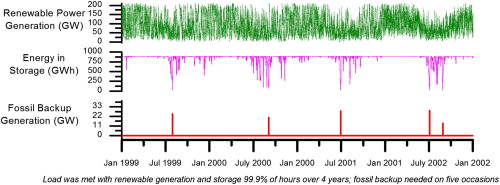
They modeled wind, solar, and storage to meet demand for 1/5 of the USA electric grid.
► 28 billion combinations of wind, solar and storage were run, seeking least-cost.
► Least-cost combinations have excess generation (3 times the load), thus require less storage.
► 99.9% of hours of load can be met by renewables with only 9–72 h of storage.
► At 2030 technology costs, 90% of load hours are met at electric costs below today’s.
They use widespread geographical distribution the intermittent sources (wind farms and photovoltaic installations) all parts of the grid would have enough power. (windy and sunny in come parts to make for calm and overcast areas in other parts)

A map showing the outlines of the current PJM system (blue line) and of the inland and offshore meteorological stations used for the wind data (pink asterisks). (For interpretation of the references to color in this figure legend, the reader is referred to the web or PDF version of this article.)
If you liked this article, please give it a quick review on ycombinator or StumbleUpon. Thanks

Brian Wang is a Futurist Thought Leader and a popular Science blogger with 1 million readers per month. His blog Nextbigfuture.com is ranked #1 Science News Blog. It covers many disruptive technology and trends including Space, Robotics, Artificial Intelligence, Medicine, Anti-aging Biotechnology, and Nanotechnology.
Known for identifying cutting edge technologies, he is currently a Co-Founder of a startup and fundraiser for high potential early-stage companies. He is the Head of Research for Allocations for deep technology investments and an Angel Investor at Space Angels.
A frequent speaker at corporations, he has been a TEDx speaker, a Singularity University speaker and guest at numerous interviews for radio and podcasts. He is open to public speaking and advising engagements.