

Berkeley Labs – A technology that would enable low-cost, high efficiency solar cells to be made from virtually any semiconductor material has been developed by researchers with the U.S. Department of Energy (DOE)’s Lawrence Berkeley National Laboratory (Berkeley Lab) and the University of California (UC) Berkeley. This technology opens the door to the use of plentiful, relatively inexpensive semiconductors, such as the promising metal oxides, sulfides and phosphides, that have been considered unsuitable for solar cells because it is so difficult to tailor their properties by chemical means.
What’s next? “This research opens up scores of new semiconductors (many metal oxides, sulfides, and phosphides) for practical photovoltaic applications, so we are currently identifying the ones with the greatest potential for low-cost, high-efficiency solar cells,” says Will Regan the lead author

Extremetech – In theory, you can dope any semiconductor — but cheaper, more-readily-available semiconductors, such as copper oxide, don’t retain dopants very well, eventually leading to the breakdown of the p-n junctions. Silicon holds dopants very well, but it isn’t cheap.
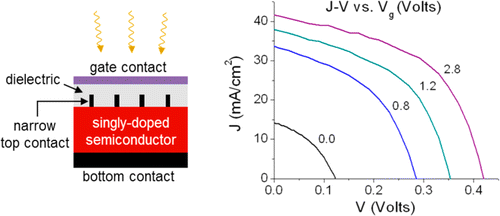
To get around this problem, the Californian researchers have developed a new type of solar cell called screening-engineered field-effect photovoltaics, or SFPV for short. Instead of physical doping, SFPVs use a minute electric field to achieve the same doping effect. While this electric field is present, the p-n junction remains and the photovoltaic cell continues to produce a lot of electricity. The energy required to produce this electric field is apparently a lot less than the energy produced by the photovoltaic effect.
Nanoletters – Screening-Engineered Field-Effect Solar Cells
ABSTRACT – Photovoltaics (PV) are a promising source of clean renewable energy, but current technologies face a cost-to-efficiency trade-off that has slowed widespread implementation. We have developed a PV architecture—screening-engineered field-effect photovoltaics (SFPV)—that in principle enables fabrication of low-cost, high efficiency PV from virtually any semiconductor, including the promising but hard-to-dope metal oxides, sulfides, and phosphides. Prototype SFPV devices have been constructed and are found to operate successfully in accord with model predictions.
Once the best material has been found, it still won’t be an easy ride: there’s a huge industry (mainly in China) dedicated to producing standard photovoltaic cells, and they lack the equipment or expertise to produce SFPVs. It isn’t quite as bad as the computer chip industry, where trillions of dollars are invested in silicon, but it will still take considerable effort to shift the industry towards SFPVs. The cost savings are there for the taking, though — and I dare say, the first company to produce solar power that’s significantly cheaper than fossil fuels is onto a winner.
If you liked this article, please give it a quick review on ycombinator or StumbleUpon. Thanks

Brian Wang is a Futurist Thought Leader and a popular Science blogger with 1 million readers per month. His blog Nextbigfuture.com is ranked #1 Science News Blog. It covers many disruptive technology and trends including Space, Robotics, Artificial Intelligence, Medicine, Anti-aging Biotechnology, and Nanotechnology.
Known for identifying cutting edge technologies, he is currently a Co-Founder of a startup and fundraiser for high potential early-stage companies. He is the Head of Research for Allocations for deep technology investments and an Angel Investor at Space Angels.
A frequent speaker at corporations, he has been a TEDx speaker, a Singularity University speaker and guest at numerous interviews for radio and podcasts. He is open to public speaking and advising engagements.