
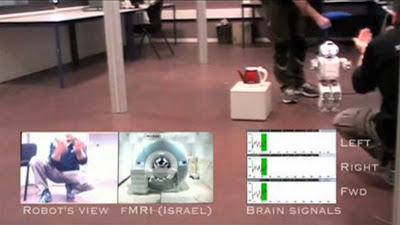
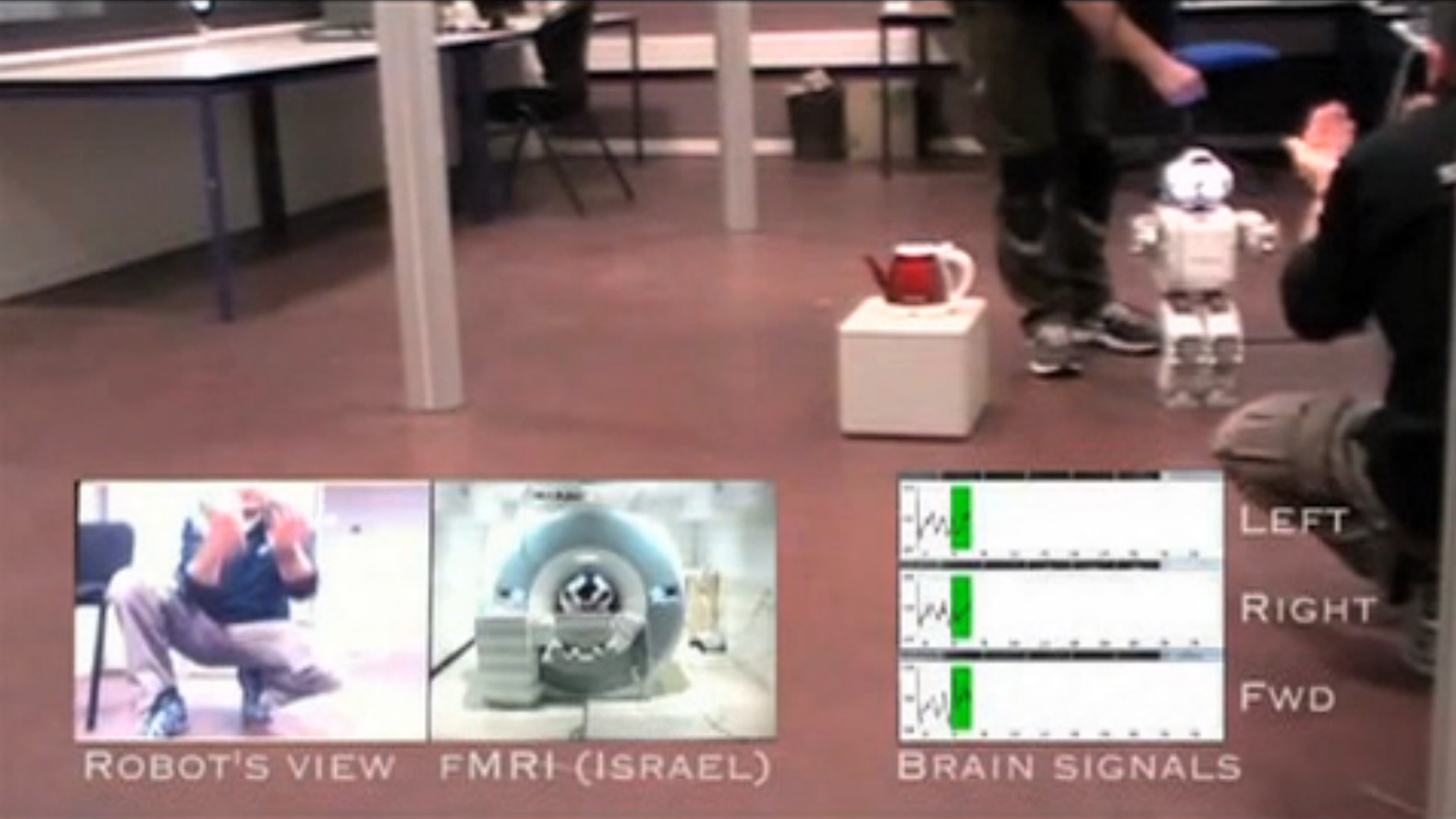
Extremetech – An Israeli student has become the first person to meld his mind and movements with a robot surrogate, or avatar. Situated inside an fMRI scanner in Israel, Tirosh Shapira has controlled a humanoid robot some 2000 kilometers (1250 miles) away, at the Béziers Technology Institute in France, using just his mind.
The fMRI (functional magnetic resonance imaging) reads his thoughts, a computer translates those thoughts into commands, and then those commands are sent across the internet to the robot in France. The system requires training: On its own, an fMRI can simply see the real-time blood flow in your brain (pictured below right). Training teaches the system that a particular “thought” (blood flow pattern) equates to a certain command. In this case, when Shapira thinks about moving forward or backward, the robot moves forward or backward; when Shapira thinks about moving one of his hands, the robot surrogate turns in that direction.
To complete the loop, the robot has a camera on its head, with the image being displayed in front of Shapira. Speaking to New Scientist, it sounds like Shapira really became one with the robot: “It was mind-blowing. I really felt like I was there, moving around,” he says. “At one point the connection failed. One of the researchers picked the robot up to see what the problem was and I was like, ‘Oi, put me down!’”
If you liked this article, please give it a quick review on ycombinator or StumbleUpon. Thanks
Brian Wang is a Futurist Thought Leader and a popular Science blogger with 1 million readers per month. His blog Nextbigfuture.com is ranked #1 Science News Blog. It covers many disruptive technology and trends including Space, Robotics, Artificial Intelligence, Medicine, Anti-aging Biotechnology, and Nanotechnology.
Known for identifying cutting edge technologies, he is currently a Co-Founder of a startup and fundraiser for high potential early-stage companies. He is the Head of Research for Allocations for deep technology investments and an Angel Investor at Space Angels.
A frequent speaker at corporations, he has been a TEDx speaker, a Singularity University speaker and guest at numerous interviews for radio and podcasts. He is open to public speaking and advising engagements.