
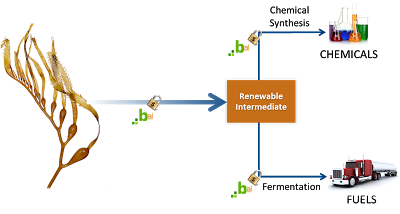
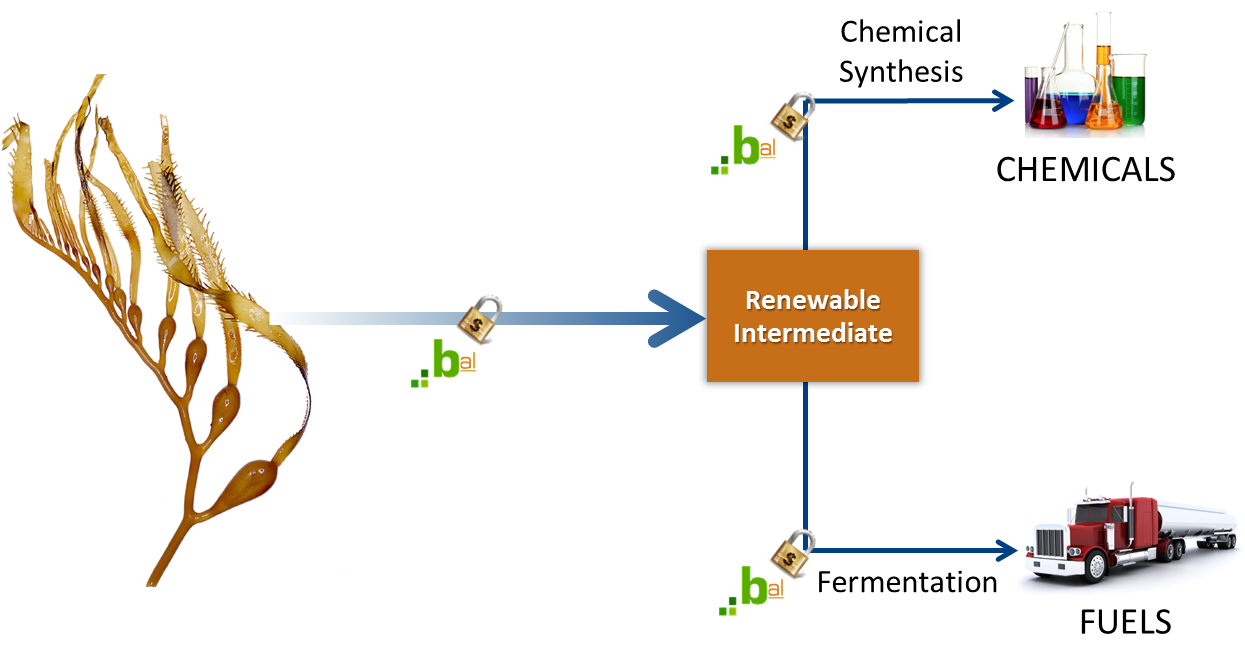
A team of scientists from Bio Architecture Lab (BAL), has developed breakthrough technology that helps to further enable the wide-scale use of seaweed (macroalgae) as a feedstock for advanced biofuels and renewable chemical production. The team engineered a microbe to extract the sugars in seaweed and convert them into renewable fuels and chemicals, thus making seaweed a real renewable biomass contender.
“About 60 percent of the dry biomass of seaweed are sugars, and more than half of those are locked in a single sugar – alginate,” said Daniel Trunfio, Chief Executive Officer at Bio Architecture Lab. “Our scientists have developed a pathway to metabolize the alginate, allowing us to unlock all the sugars in seaweed, which therefore makes macroalgae an economical alternative feedstock for the production of renewable fuels and chemicals.”
Science – An Engineered Microbial Platform for Direct Biofuel Production from Brown Macroalgae
The key benefits of BAL technology are:
* Single Platform. BAL converts seaweed carbohydrates into one renewable chemical intermediate that is affordable and scalable for both fuels and chemicals.
* Commercial Focus. Leveraging the single platform, BAL will first commercialize high-value products to generate early cash flow that simultaneously paves the path for larger market opportunities.
* First Mover Advantage. With over 60 patents or patents pending, BAL has carved a broad IP estate for the use of seaweed as a biomass for chemicals and fuels.
Prospecting macroalgae (seaweeds) as feedstocks for bioconversion into biofuels and commodity chemical compounds is limited primarily by the availability of tractable microorganisms that can metabolize alginate polysaccharides. Here, we present the discovery of a 36–kilo–base pair DNA fragment from Vibrio splendidus encoding enzymes for alginate transport and metabolism. The genomic integration of this ensemble, together with an engineered system for extracellular alginate depolymerization, generated a microbial platform that can simultaneously degrade, uptake, and metabolize alginate. When further engineered for ethanol synthesis, this platform enables bioethanol production directly from macroalgae via a consolidated process, achieving a titer of 4.7% volume/volume and a yield of 0.281 weight ethanol/weight dry macroalgae (equivalent to about 80% of the maximum theoretical yield from the sugar composition in macroalgae).
25 pages of supplemental material
If you liked this article, please give it a quick review on ycombinator or StumbleUpon. Thanks

Brian Wang is a Futurist Thought Leader and a popular Science blogger with 1 million readers per month. His blog Nextbigfuture.com is ranked #1 Science News Blog. It covers many disruptive technology and trends including Space, Robotics, Artificial Intelligence, Medicine, Anti-aging Biotechnology, and Nanotechnology.
Known for identifying cutting edge technologies, he is currently a Co-Founder of a startup and fundraiser for high potential early-stage companies. He is the Head of Research for Allocations for deep technology investments and an Angel Investor at Space Angels.
A frequent speaker at corporations, he has been a TEDx speaker, a Singularity University speaker and guest at numerous interviews for radio and podcasts. He is open to public speaking and advising engagements.