

Intel already has 14nm circuits up and running in the lab, this was revealed by Pat Bliemer, Managing Director Intel Northern Europe, in an interview with NordicHardware. Bliemer says that even though the manufacturing technology is becoming all the more complicated Intel is well in phase with current roadmaps.
“We need to keep going and you can trust me that in our labs we actually have the next generation after 22nm running, so we need to keep going…. I cannot really disclose more about that other than that in a laboratory environment, absolutely we do have the path, our engineers do have the path to actually go and produce 14-nm products,” the report quoted Bliemer as saying.
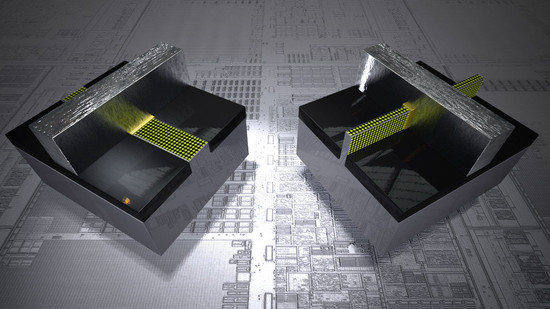
A 2D (planar) transistor compared to a 3D (tri-gate) transistor
Pat Bliemer could also confirm that Intel’s Tick-Tock strategy are going as planned and that it is not the shrinking of the manufacturing process that is moving Intel forward, but also the introduction of new solutions in the transistor design. Intel’s Tri-gate transistors will be introduced with the 22nm process and offer great advantages, but also something that will come to full use in the next generation 14 nanometer process.
“There are many variables that you can play with of course it is not the right name for it and the engineers would not like it when I say play, that you can influence to actually go and stay to that model. And I think the breakthrough we had now with the 3D metal gates, just the design of the gate will actually allow for much more efficient thermals and power.”
If you liked this article, please give it a quick review on ycombinator or StumbleUpon. Thanks
Brian Wang is a Futurist Thought Leader and a popular Science blogger with 1 million readers per month. His blog Nextbigfuture.com is ranked #1 Science News Blog. It covers many disruptive technology and trends including Space, Robotics, Artificial Intelligence, Medicine, Anti-aging Biotechnology, and Nanotechnology.
Known for identifying cutting edge technologies, he is currently a Co-Founder of a startup and fundraiser for high potential early-stage companies. He is the Head of Research for Allocations for deep technology investments and an Angel Investor at Space Angels.
A frequent speaker at corporations, he has been a TEDx speaker, a Singularity University speaker and guest at numerous interviews for radio and podcasts. He is open to public speaking and advising engagements.
