

The researchers achieved most surprising results when they manipulated membrane voltage of cells in the tadpole’s back and tail, well outside of where the eyes could normally form. “The hypothesis is that for every structure in the body there is a specific membrane voltage range that drives organogenesis,” said Tufts post-doctoral fellow Vaibhav P. Pai Ph.D., first author of the paper, entitled “Transmembrane Voltage Potential Controls Embryonic Eye Patterning in Xenopus laevis.” Pai noted, “These were cells in regions that were never thought to be able to form eyes. This suggests that cells from anywhere in the body can be driven to form an eye.”
To do this, they changed the voltage gradient of cells in the tadpoles’ back and tail to match that of normal eye cells. The eye-specific gradient drove the cells in the back and tail—which would normally develop into other organs—to develop into eyes.
These findings break new ground in the field of biomedicine because they identify an entirely new control mechanism that can be capitalized upon to induce the formation of complex organs for transplantation or regenerative medicine applications, according to Michael Levin, Ph.D., professor of biology and director of the Center for Regenerative and Developmental Biology at Tufts University’s School of Arts and Sciences
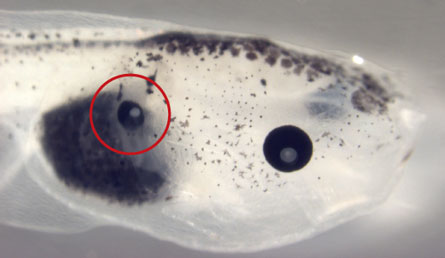
Eye grown in gut of tadpole
Electric Properties of Cells Can Be Manipulated to Generate Specific Organs
The researchers achieved most surprising results when they manipulated membrane voltage of cells in the tadpole’s back and tail, well outside of where the eyes could normally form.
“The hypothesis is that for every structure in the body there is a specific membrane voltage range that drives organogenesis,” said Pai. “By using a specific membrane voltage, we were able to generate normal eyes in regions that were never thought to be able to form eyes. This suggests that cells from anywhere in the body can be driven to form an eye.”
Levin and his colleagues are pursuing further research, additionally targeting the brain, spinal cord, and limbs. The findings, he said “will allow us to have much better control of tissue and organ pattern formation in general. We are developing new applications of molecular bioelectricity in limb regeneration, brain repair, and synthetic biology.”
If you liked this article, please give it a quick review on ycombinator or StumbleUpon. Thanks

Brian Wang is a Futurist Thought Leader and a popular Science blogger with 1 million readers per month. His blog Nextbigfuture.com is ranked #1 Science News Blog. It covers many disruptive technology and trends including Space, Robotics, Artificial Intelligence, Medicine, Anti-aging Biotechnology, and Nanotechnology.
Known for identifying cutting edge technologies, he is currently a Co-Founder of a startup and fundraiser for high potential early-stage companies. He is the Head of Research for Allocations for deep technology investments and an Angel Investor at Space Angels.
A frequent speaker at corporations, he has been a TEDx speaker, a Singularity University speaker and guest at numerous interviews for radio and podcasts. He is open to public speaking and advising engagements.