

A research team working under Natcore Technology Inc. co-founder Prof. Andrew Barron has fabricated two families of multilayer quantum dot films, one with silicon quantum dots and the other with germanium quantum dots, both of which have demonstrated the ability to produce a photo-generated current. Natcore’s scientists have discovered that its LPD (Liquid Phase Deposition) process could allow, for the first time, mass manufacturing of super-efficient (30%+) tandem solar cells. For comparison purposes, these cells could achieve twice the power output of today’s most efficient solar cells. Until now, these tandem cells have been producible only by using very special, expensive semiconductor materials, and at very high costs. Natcore’s process has the potential to allow tandem cell mass production at a lower cost/watt than anything available today.
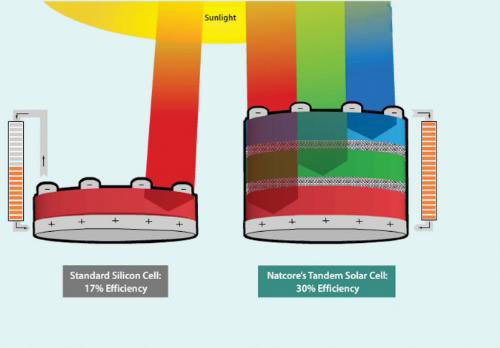
The photo-generated current measurements are the first of their kind for this sort of structure and showed unequivocally that both film types (i.e., with Si quantum dots or Ge quantum dots) were photoactive in different spectral regions. The larger Ge quantum dots were responsive to an infrared-rich light source and the Si quantum dots were responsive to a UV-rich light source, consistent with expectations. Smaller quantum dots (the Si quantum dot diameters were between 1 nm and 2 nm) will respond more readily to shorter wavelengths of light, while larger quantum dots (the Ge quantum dot diameters were between 5 nm and 6 nm) will respond more readily to longer light wavelengths, precisely as observed.
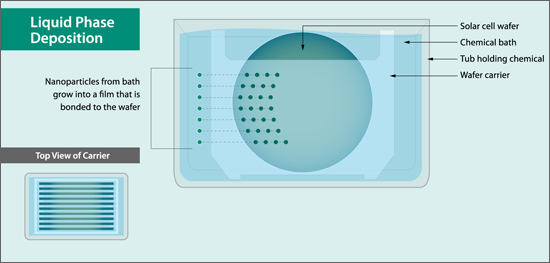
“This accomplishment by Professor Barron and his group is an outstanding achievement and confirms that making, and ultimately commercially producing, an all-quantum dot tandem solar cell using Natcore’s LPD film growth technology is on target,” said Dr. Dennis Flood, Natcore’s Chief Technology Officer. “Our goal to show that multiple layers of quantum dots can be assembled using a low-cost, complete wet chemistry approach has been validated. The fact that we have demonstrated photocurrent generation in both Si and Ge quantum dot multilayer devices means that the entire solar cell could potentially be fabricated without the use of expensive silicon wafers for the bottom subcell of a two- or three-cell tandem device. We could do so by substituting a Ge quantum dot device for the silicon solar cell and achieve the same overall solar absorption as would have been achieved with the latter. This achievement could make it possible to use low-cost, roll-to-roll manufacturing techniques to achieve a truly low-cost solar module that would have twice the power output of the average solar module on the market today. “
If you liked this article, please give it a quick review on ycombinator or StumbleUpon. Thanks

Brian Wang is a Futurist Thought Leader and a popular Science blogger with 1 million readers per month. His blog Nextbigfuture.com is ranked #1 Science News Blog. It covers many disruptive technology and trends including Space, Robotics, Artificial Intelligence, Medicine, Anti-aging Biotechnology, and Nanotechnology.
Known for identifying cutting edge technologies, he is currently a Co-Founder of a startup and fundraiser for high potential early-stage companies. He is the Head of Research for Allocations for deep technology investments and an Angel Investor at Space Angels.
A frequent speaker at corporations, he has been a TEDx speaker, a Singularity University speaker and guest at numerous interviews for radio and podcasts. He is open to public speaking and advising engagements.