
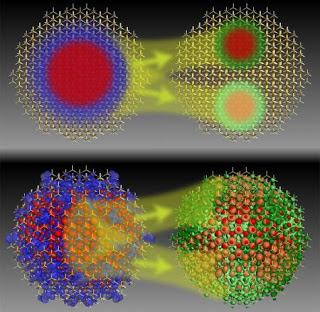
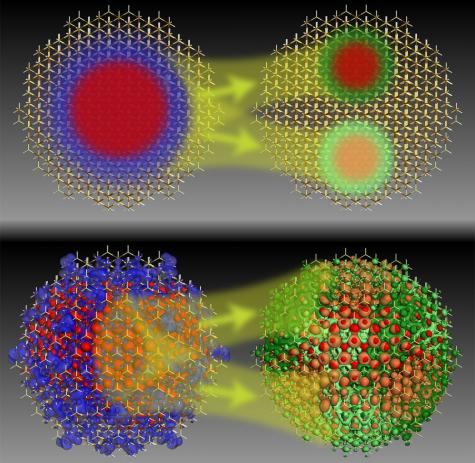
Illustration of multiple-exciton generation (MEG), a theory that suggests it is possible for an electron that has absorbed light energy, called an exciton, to transfer that energy to more than one electron, resulting in more electricity from the same amount of absorbed light. The left side shows an electron promoted to a high energy state (blue) plus the “hole” vacated by the electron (red). The right side shows the original exciton (now dark green/red) and a new exciton (light green/orange) after MEG. The top image shows a conceptualized version of the idea, while the bottom shows an actual exciton and bi-exciton using the same color scheme.
Credit: Mark T. Lusk, Department of Physics, Colorado School of Mines
Studies done by Mark Lusk and colleagues at the Colorado School of Mines could significantly improve the efficiency of solar cells. Their latest work describes how the size of light-absorbing particles–quantum dots–affects the particles’ ability to transfer energy to electrons to generate electricity.
The results are published in the April issue of the journal ACS Nano.
The advance provides evidence to support a controversial idea, called multiple-exciton generation (MEG), which theorizes that it is possible for an electron that has absorbed light energy, called an exciton, to transfer that energy to more than one electron, resulting in more electricity from the same amount of absorbed light.
Quantum dots are man-made atoms that confine electrons to a small space. They have atomic-like behavior that results in unusual electronic properties on a nanoscale. These unique properties may be particularly valuable in tailoring the way light interacts with matter.
Experimental verification of the link between MEG and quantum dot size is a hot topic due to a large degree of variation in previously published studies. The ability to generate an electrical current following MEG is now receiving a great deal of attention because this will be a necessary component of any commercial realization of MEG.
According to Lusk, “We can now design nanostructured materials that generate more than one exciton from a single photon of light, putting to good use a large portion of the energy that would otherwise just heat up a solar cell.”
If you liked this article, please give it a quick review on ycombinator or StumbleUpon. Thanks

Brian Wang is a Futurist Thought Leader and a popular Science blogger with 1 million readers per month. His blog Nextbigfuture.com is ranked #1 Science News Blog. It covers many disruptive technology and trends including Space, Robotics, Artificial Intelligence, Medicine, Anti-aging Biotechnology, and Nanotechnology.
Known for identifying cutting edge technologies, he is currently a Co-Founder of a startup and fundraiser for high potential early-stage companies. He is the Head of Research for Allocations for deep technology investments and an Angel Investor at Space Angels.
A frequent speaker at corporations, he has been a TEDx speaker, a Singularity University speaker and guest at numerous interviews for radio and podcasts. He is open to public speaking and advising engagements.