

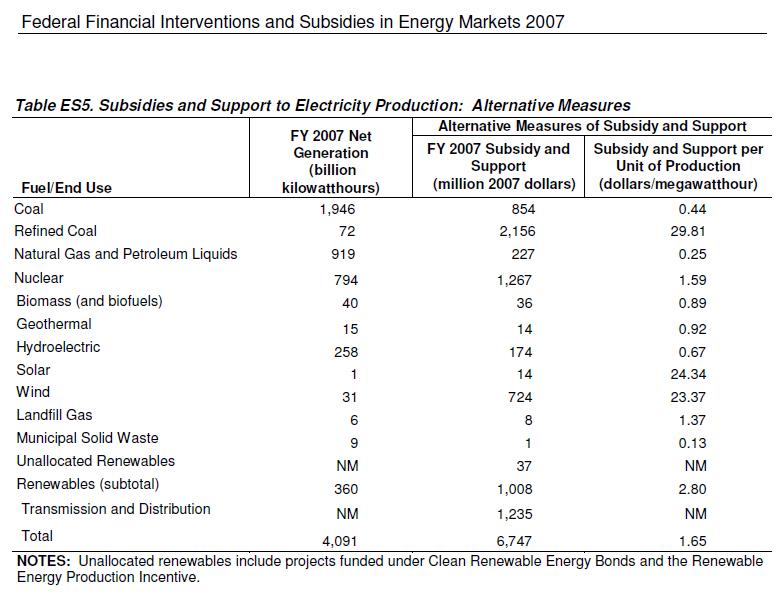
Source – subsidy and support in dollars per megawatt-hour (mills per kilowatt-hour)
Subsidy and Support per
                      Unit of Production
                      (dollars/megawatthour) as of 2007

Nuclear                  1.59
Coal                     0.44  (does not include externalities like air pollution
                                or acid rain damage)
Refined coal            29.81
Natural gas              0.25
Biomass (and biofuels)   0.89
Geothermal               0.92
Hydroelectric            0.67
Solar                   24.34
Wind                    23.37
Landfill Gas             1.37
Municipal Solid Waste    0.13
Renewables (average)     2.80  (Hydro is making it better)
Total (average)          1.65
Coal – world average               161 (26% of world energy, 50% of electricity)
Coal – China                       278
Coal – USA                         15
Oil                                36  (36% of world energy)
Natural Gas                         4  (21% of world energy)
Biofuel/Biomass                    12
Peat                               12
Solar (rooftop)                     0.44 (less than 0.1% of world energy)
Wind                                0.15 (less than 1% of world energy)
Hydro                               0.10 (europe death rate, 2.2% of world energy)
Hydro - world including Banqiao)    1.4 (about 2500 TWh/yr and 171,000 Banqiao dead)
Nuclear                             0.04 (5.9% of world energy)
The way they wrote their article and study the implication is that nuclear energy is alone in getting subsidies and alone with any safety issues. The implication might also be if not alone at least far worse than the other energy.
This is wrong. Nuclear is among the safest energy sources. Nuclear gets less subsidy than most of the other energy sources per the amount of energy generated.
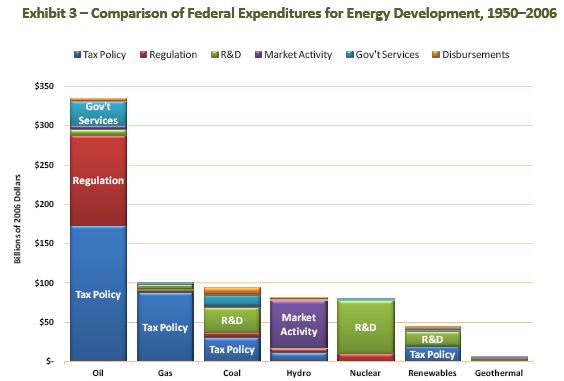
In terms of overall money, oil gets far more of the $550 billion in energy subsidies in 2008 worldwide.
If you liked this article, please give it a quick review on ycombinator or StumbleUpon. Thanks
Brian Wang is a Futurist Thought Leader and a popular Science blogger with 1 million readers per month. His blog Nextbigfuture.com is ranked #1 Science News Blog. It covers many disruptive technology and trends including Space, Robotics, Artificial Intelligence, Medicine, Anti-aging Biotechnology, and Nanotechnology.
Known for identifying cutting edge technologies, he is currently a Co-Founder of a startup and fundraiser for high potential early-stage companies. He is the Head of Research for Allocations for deep technology investments and an Angel Investor at Space Angels.
A frequent speaker at corporations, he has been a TEDx speaker, a Singularity University speaker and guest at numerous interviews for radio and podcasts. He is open to public speaking and advising engagements.