


Lockheed Martin’s is working on the P791 Hybrid Air Vehicle. It can be designed as an unmanned or manned intelligence gatherer or transport vehicle. As an eye in the sky, this remarkable airship can stay aloft for up to three weeks at an altitude of 20,000 feet. Loaded with cameras, infrared sensors, communications relays, and other payloads, the Hybrid Air Vehicle can provide American and allied forces a clear picture of the battlefield. As a transport vehicle, the Hybrid Air Vehicle can be sized to move equipment and troops cost effectively to unimproved forward areas.
* Land and take off on any reasonably flat surface: water, snow, sand and tundra.
* Land and take off vertically.
* Burn less fuel than existing aircraft, often less than 25%.
* Deliver freight to destinations inaccessible to other modes of transport.
* Provide unique surveillance and interdiction solutions.
We are launching a new family of environmentally friendly Hybrid Air Vehicles (HAV) known as SkyCat, with payloads spanning 20 to 1000 tons, operating at heights up to 10,000ft at speeds between 90 and 120 knots, with endurance up to 5 days. The SkyCat’s ability to operate autonomously onto any surface including water, snow, marsh and unprepared ground allied to little or no requirement for ground infrastructure or ground crew, makes it a ‘market changing’ transformational concept.
All variants of SkyCat consume as much as 70% less fuel per tonne kilometer than conventional aircraft.
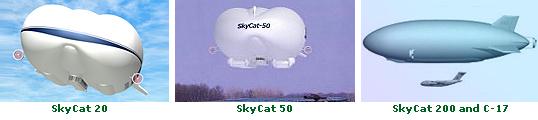
The P-791 appears to be essentially identical in design to the SkyCat design unsuccessfully promoted by the now defunct British company Advanced Technologies Group (ATG). SkyCat technologies are once again being developed and promoted in the US by the Hybrid Aircraft Corporation (HAC) located in New Mexico. Press reports have also confirmed that the P-791 incorporates some of the most distinctive design features of the SkyCat, specifically the use of hover/suction skirts as “landing gear.” Industry observers have noted that engineering individuals closely associated with HAC later worked on the WALRUS project and P-791 at Lockheed-Martin.
Northrop Grumman has a $517 million order for hybrid airships Northrop partnered with Hybrid Air Vehicles on the contract.
If you liked this article, please give it a quick review on ycombinator or StumbleUpon. Thanks
Featured articles
Ocean Floor Gold and Copper
Ocean Floor Mining Company

Brian Wang is a Futurist Thought Leader and a popular Science blogger with 1 million readers per month. His blog Nextbigfuture.com is ranked #1 Science News Blog. It covers many disruptive technology and trends including Space, Robotics, Artificial Intelligence, Medicine, Anti-aging Biotechnology, and Nanotechnology.
Known for identifying cutting edge technologies, he is currently a Co-Founder of a startup and fundraiser for high potential early-stage companies. He is the Head of Research for Allocations for deep technology investments and an Angel Investor at Space Angels.
A frequent speaker at corporations, he has been a TEDx speaker, a Singularity University speaker and guest at numerous interviews for radio and podcasts. He is open to public speaking and advising engagements.