
Ad Support : Nano Technology Netbook Technology News Computer Software

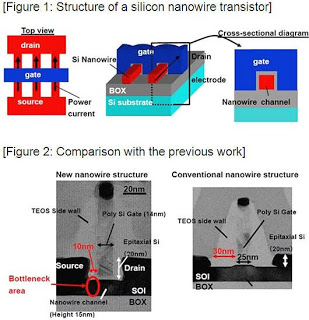
The company said it has achieved 1-mA per micron on-current, the world’s highest level for a nanowire transistor, by reducing parasitic resistance and improving the on-current level by 75 percent.
The silicon nanowire transistor can suppress off-leakage and achieve further short-channel operation, because its thin wire-shaped silicon channel (nanowire channel) is effectively controlled by the surrounding gate. However, parasitic resistance in the nanowire-shaped source/drain, especially in the region under the gate sidewall, degrades the on-current. Toshiba claims to have overcome this problem by optimizing gate fabrication and significantly reducing the thickness of the gate sidewall, from 30-nm to 10-nm. Low parasitic resistance was realized by epitaxial silicon growth on the source/drain with a thin gate sidewall, which leads to a 40 percent increase in on-current. The company also achieved a further 25 percent increase in current performance by changing the direction of the silicon nanowire channel
If you liked this article, please give it a quick review on Reddit, or StumbleUpon. Thanks
Supporting Advertising
Business Success
How to Make Money
Executive Jobs
Paid Surveys
Thank You
Brian Wang is a Futurist Thought Leader and a popular Science blogger with 1 million readers per month. His blog Nextbigfuture.com is ranked #1 Science News Blog. It covers many disruptive technology and trends including Space, Robotics, Artificial Intelligence, Medicine, Anti-aging Biotechnology, and Nanotechnology.
Known for identifying cutting edge technologies, he is currently a Co-Founder of a startup and fundraiser for high potential early-stage companies. He is the Head of Research for Allocations for deep technology investments and an Angel Investor at Space Angels.
A frequent speaker at corporations, he has been a TEDx speaker, a Singularity University speaker and guest at numerous interviews for radio and podcasts. He is open to public speaking and advising engagements.