

Chemical engineers at Princeton developed a method for shooting stable jets of electrically charged liquids from a wide nozzle. The technique, which produced lines just 100 nanometers wide (about one ten-thousandth of a millimeter), offers at least 10 times better resolution than ink-jet printing and far more speed and ease than conventional nanotechnology. The new technique can lay down lines at the rate of meters per second as opposed to millionths of a meter per second. The researchers were able to use a nozzle that is half a millimeter wide, or 5,000 times wider than the lines it produced. This also can improve some kinds of rapid prototyping, rapid manufacturing, fabbers and for medical applications like printing organs.
The key to the process is something called an “electrohydrodynamic (EHD) jet” — a stream of liquid forced from a nozzle by a very strong electric field. In the past, the stream from such a process is unstable, but researchers produced a stable stream.
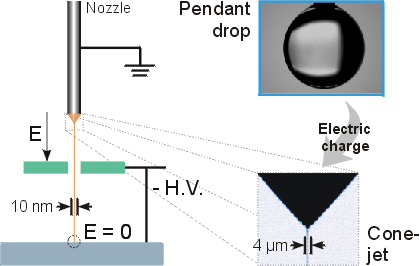
Schematic of EHDP. The suspension is first deployed by field-assisted flow in the form of a thin continuous filament. Rapid evaporation suppresses the Rayleigh instability and the feature shape is fixed by radiation or heating.
The result is highly practical not only because of the fineness of the stream but also because the large size of the nozzle and the distance from the nozzle to the printed surface will prevent clogs or jams.
a chief use for the technique could be in printing electrically conducting organic polymers (plastics) that could be the basis for large electronic devices. Conventional techniques for making wires of that size (100 nanometers) require laboriously etching the lines with a beam of electrons, which can only be done in very small areas. The new technique can lay down lines at the rate of meters per second as opposed to millionths of a meter per second.
Another application would be to use a liquid that solidifies into a fiber for making precise three-dimensional lattices. Such a product could be used as a scaffold to promote blood clotting in wounds and in other medical devices.
Princeton University has filed for a patent on the discovery and has licensed rights to Vorbeck Materials Corp., a specialty chemical company based in Maryland.
“Electronics is a huge potential application for this discovery,” said John Lettow, president of Vorbeck and a 1995 chemical engineering alumnus of Princeton. “The printing technique could greatly increase the size of video displays and the speed with which high performance displays are made.” Lettow said the technique also could be used in creating large sensors that collect information over a wide area, such as a sensor printed onto an airplane wing to detect metal fatigue.
FURTHER READING
Link to a video image of the straight and whipping jets.
Electrohydrodynamic Printing (EHDP) site at Princeton which is part of the larger Ceramic Materials Laboratory The Ceramic Materials Laboratory is doing a lot of interesting work.
The ability to decorate surfaces with micron or nanometer-scale features is of increasing importance for various applications, such as photonic materials [1,2], high-density magnetic data storage devices [3], microchip reactors [4] and biosensors [5]. One method of preparing such structures is through the hierarchical assembly of colloidal particles [6-10]. Colloidal particles are used since they can be synthesized in a variety of shapes and sizes from different precursor materials. Micropatterned colloidal assemblies have been produced with lithographically patterned electrodes [5,11] or micromolds [12,13]. An alternative approach is the category of direct writing techniques where patterns are formed by direct transfer of precursor materials without using masks or molds. Printed circuit board [14], transistor circuits [15], array-based nanostructures [16] and biosensors [17] have been made.
The research paper: (RJ148 ) S. Korkut, D.A. Saville, I.A. Aksay, “Enhanced Stability of Electrohydrodynamic Jets through Gas Ionization,” Phys. Rev. Lett. 100 (in press) (2008)
Links to publications of the Electrohydrodynamic Printing (EHDP) group at Princeton

Brian Wang is a Futurist Thought Leader and a popular Science blogger with 1 million readers per month. His blog Nextbigfuture.com is ranked #1 Science News Blog. It covers many disruptive technology and trends including Space, Robotics, Artificial Intelligence, Medicine, Anti-aging Biotechnology, and Nanotechnology.
Known for identifying cutting edge technologies, he is currently a Co-Founder of a startup and fundraiser for high potential early-stage companies. He is the Head of Research for Allocations for deep technology investments and an Angel Investor at Space Angels.
A frequent speaker at corporations, he has been a TEDx speaker, a Singularity University speaker and guest at numerous interviews for radio and podcasts. He is open to public speaking and advising engagements.