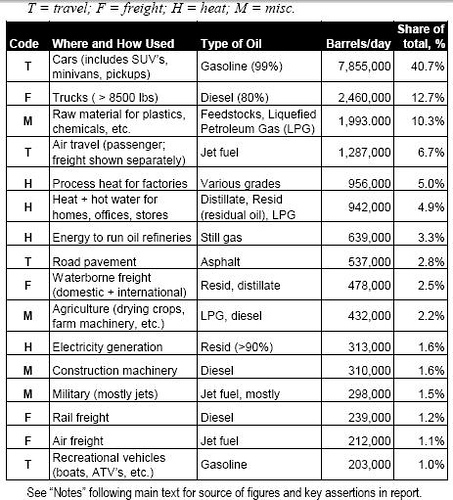
Efficiency is vital for economic and environmental reasons. We need to be efficient for the right reasons-- because it's smart.
There are over 1 million oil wells in the US and fewer than 500 in either Saudi Arabia or Iraq. Production methods in the middle east are slip-shod, and lead to recovery of oil from any field of less than 20% of oil present.
Peak Oil projections by the IEA and others that focus on production figures will always vastly underestimate the oil in place--because for political and technical reasons, oil fields are not being effectively utilised, and large numbers of sedimentary basins are still unexplored.
The best future is one where humans do not use oil and coal for energy because they have better fuels and power generation methods. Artificial scarcity such as we have currently is good for oil-producing countries and corps., but it shrouds the underlying reality--which is likely to bite forecasters in the posterior.
If you haven't read "The Age of Oil" by Eni exec Maugeri, look it up.
I enjoyed your comments on Peak Oil over at Futurepundit, Brian. Here's more from The Age of Oil:
During the last 25 years more than 70% of exploration has taken place in the United States and Canada, mature areas that probably hold only 3% of the world's reserves of crude. The Middle East, on the other hand, has been the scene of only 3% of global exploration, even though it harbors 70% of the earth's reserves. In the Persian Gulf, holding 65% of the region's reserves, fewer than 100 exploration wells were drilled between 1995 and 2004. During the same period, 15,700 such wells were drilled in the U.S. Forbes
Current high prices for oil do not come from scarcity of oil in the ground. They come from decisions made by government controlled oil companies inside the authoritarian countries that contain most of the world's oil.
This blog is an Amazon affiliate. Help support Nextbigfuture by making purchases through Amazon links on this site.
About Nextbigfuture
Editor/Authors are :
Brian Wang, Director of Research.
Sander Olson, Interviews and other articles
Phil Wolff, Communications and social technologist.
Alvin Wang. Computer, technology, social networking, and social media expert.
3 comments:
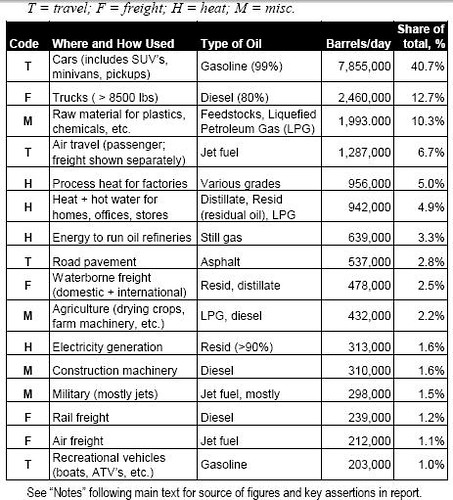
That really puts our energy use into perspective!
Thanks for all the great work you are doing, Brian! Have a great Thanksgiving!
Nice table, Brian.
Efficiency is vital for economic and environmental reasons. We need to be efficient for the right reasons-- because it's smart.
There are over 1 million oil wells in the US and fewer than 500 in either Saudi Arabia or Iraq. Production methods in the middle east are slip-shod, and lead to recovery of oil from any field of less than 20% of oil present.
Peak Oil projections by the IEA and others that focus on production figures will always vastly underestimate the oil in place--because for political and technical reasons, oil fields are not being effectively utilised, and large numbers of sedimentary basins are still unexplored.
The best future is one where humans do not use oil and coal for energy because they have better fuels and power generation methods. Artificial scarcity such as we have currently is good for oil-producing countries and corps., but it shrouds the underlying reality--which is likely to bite forecasters in the posterior.
If you haven't read "The Age of Oil" by Eni exec Maugeri, look it up.
I enjoyed your comments on Peak Oil over at Futurepundit, Brian. Here's more from The Age of Oil:
During the last 25 years more than 70% of exploration has taken place in the United States and Canada, mature areas that probably hold only 3% of the world's reserves of crude. The Middle East, on the other hand, has been the scene of only 3% of global exploration, even though it harbors 70% of the earth's reserves. In the Persian Gulf, holding 65% of the region's reserves, fewer than 100 exploration wells were drilled between 1995 and 2004. During the same period, 15,700 such wells were drilled in the U.S. Forbes
Here's my look at The Age of Oil, and here's the link at Amazon.
Current high prices for oil do not come from scarcity of oil in the ground. They come from decisions made by government controlled oil companies inside the authoritarian countries that contain most of the world's oil.
Post a Comment